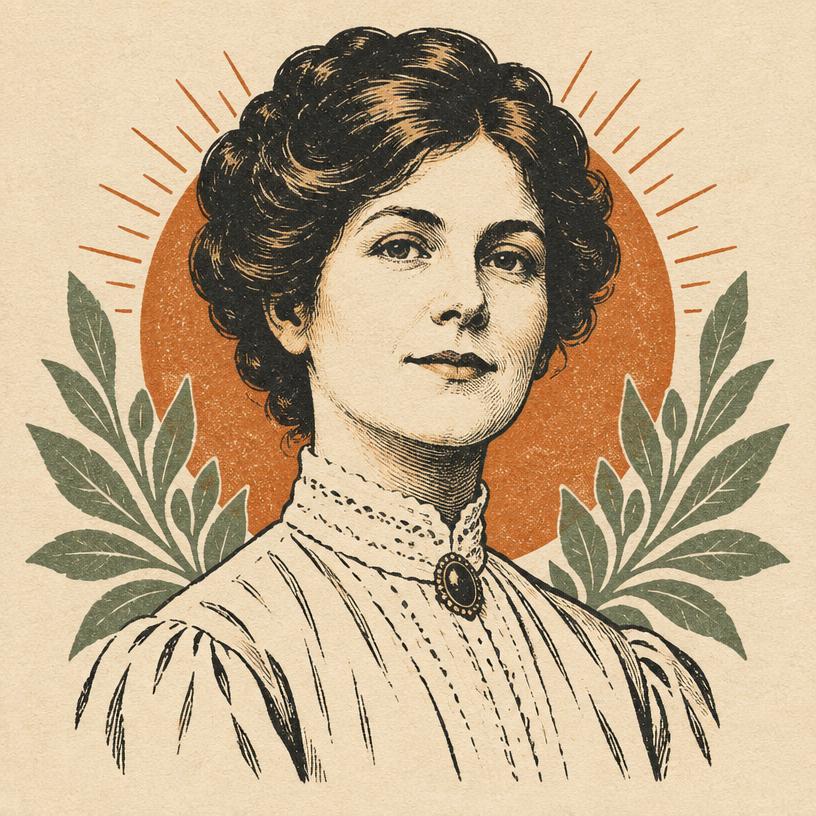
Original editorial artwork; not a historical photograph.
Legacy · 1881–1960
Genevieve Behrend
Troward's only personal student, and the teacher who carried his thinking to American audiences.
Widowed young and left with a modest inheritance, Behrend spent much of it traveling to England to study with Thomas Troward, who had never taken a private pupil. She studied with him for two years.
She returned to lecture across the United States and to write the two short books that translate Troward's dense reasoning into usable practice.
2
years studying with Troward
1921
Your Invisible Power
Only
student Troward accepted
Ideas associated with the work
- Visualization with feeling
- Mental picture-making
- Attraction through attention
- Relation of the individual to the universal
Start with the most famous book
Your Invisible Power
“Your mind is the instrument of the Universal Mind; use it as such.”
— Genevieve Behrend, Your Invisible Power (1921)
Why this master matters
Behrend was Thomas Troward's only personal student. She translated his dense legal reasoning into warm, practical instruction, and in doing so preserved a lineage that might otherwise have stayed academic.
Ideas in practice
Understand the teaching.
01
Mental picturing
Hold a clear, specific image of the outcome rather than a vague wish. Detail is the work.
02
Study with a teacher
Her own story argues for apprenticeship: she sought Troward out and stayed until she understood.
03
Translate, don't dilute
She simplified the language without losing the structure, which is why her books still hold up.
Signature works
Start with the books.
Explore a short reading list, with purchasing links that support ManyMasters.
Start here
Your Invisible Power
Troward's philosophy made usable — short, direct and written for someone who wants to apply it this week.
Explore editionsChoosing an edition
These titles are long out of copyright, so editions range from careful annotated reprints to hasty print-on-demand scans. Before buying, check that the listing names a publisher, shows a readable interior sample, and keeps the original chapter structure intact.

Affiliate disclosure: ManyMasters may earn a commission from qualifying purchases, at no additional cost to you.
Choose your path
Read for what you need now.
Historical context
This work belongs to the late-nineteenth and early-twentieth century New Thought movement. Read it as historical writing on belief, attention and character rather than as medical, psychological or financial advice, and treat the biographical stories that grew up around these figures as tradition rather than documented fact.