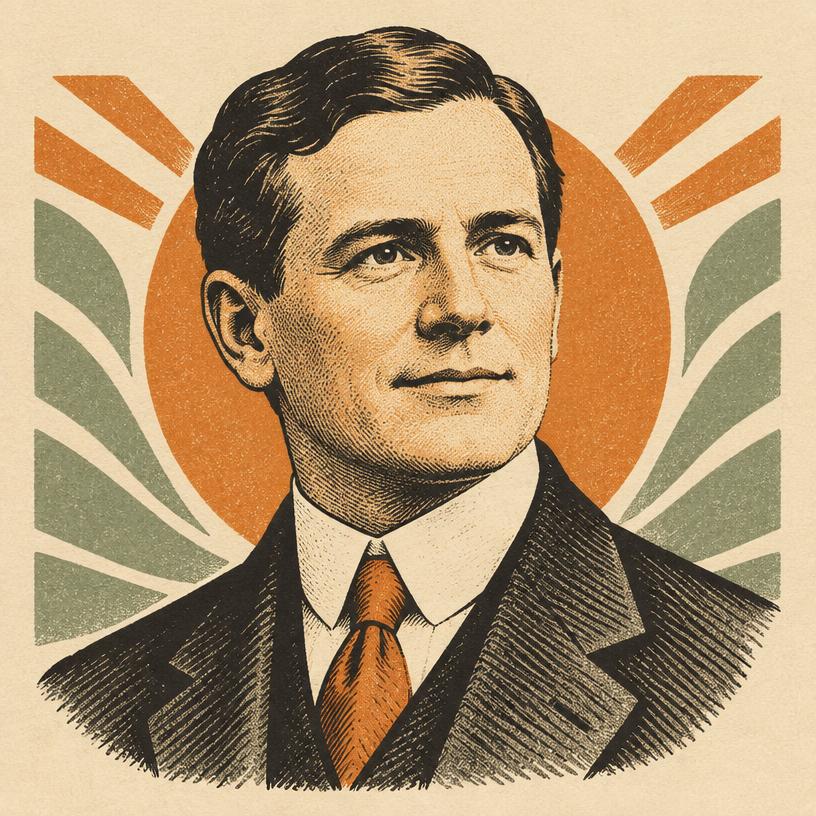
Original editorial artwork; not a historical photograph.
Legacy · 1874–1954
Christian D. Larson
A prolific optimist whose Promise Yourself creed is still read aloud in rooms that have never heard his name.
Larson founded the New Thought Temple in Cincinnati and edited Eternal Progress, writing dozens of books on the latent powers he believed ordinary people left unused.
His Optimist Creed was adopted by Optimist International and remains his most widely circulated piece of writing.
40+
books published
1912
Optimist Creed written
Editor
of Eternal Progress
Ideas associated with the work
- Latent powers awaiting use
- Optimism as a deliberate stance
- Perpetual increase
- Mastery of attitude
Start with the most famous book
Your Forces and How to Use Them
“Promise yourself to be so strong that nothing can disturb your peace of mind.”
— Christian D. Larson, The Optimist Creed, from Your Forces and How to Use Them (1912)
Why this master matters
Larson wrote the Optimist Creed, adopted by Optimist International and still recited worldwide — arguably the most widely spoken text produced by this entire movement, by a man most people have never heard of.
Ideas in practice
Understand the teaching.
01
Promise yourself
The creed is a set of commitments rather than affirmations — things to do, stated as vows.
02
Latent forces
Larson assumes most capacity goes unused, and treats development as excavation rather than acquisition.
03
Cheerfulness as strength
His optimism is disciplined: a chosen stance held under pressure, not a sunny mood.
Signature works
Start with the books.
Explore a short reading list, with purchasing links that support ManyMasters.
Start here
Your Forces and How to Use Them
His fullest work on developing latent capacity, and the source of the creed.
Explore editionsChoosing an edition
These titles are long out of copyright, so editions range from careful annotated reprints to hasty print-on-demand scans. Before buying, check that the listing names a publisher, shows a readable interior sample, and keeps the original chapter structure intact.

Affiliate disclosure: ManyMasters may earn a commission from qualifying purchases, at no additional cost to you.
Choose your path
Read for what you need now.
Historical context
This work belongs to the late-nineteenth and early-twentieth century New Thought movement. Read it as historical writing on belief, attention and character rather than as medical, psychological or financial advice, and treat the biographical stories that grew up around these figures as tradition rather than documented fact.