
Original editorial artwork; not a historical photograph.
Legacy · 1854–1948 / 1845–1931
Charles & Myrtle Fillmore
The couple who founded Unity and turned metaphysical practice into a global prayer ministry.
Myrtle Fillmore recovered from tuberculosis after attending a New Thought lecture and began praying with neighbors; Charles, a skeptical real-estate man, followed her into study. Together they founded Unity in Kansas City in 1889.
Unity's Silent Unity prayer line, Daily Word magazine, and publishing arm carried the movement to millions of households and are still operating.
1889
Unity founded
1924
Daily Word launched
Global
prayer ministry
Ideas associated with the work
- Prayer as an everyday practice
- Twelve spiritual powers
- Health as a spiritual matter
- Metaphysical reading of scripture
Start with the most famous book
Prosperity
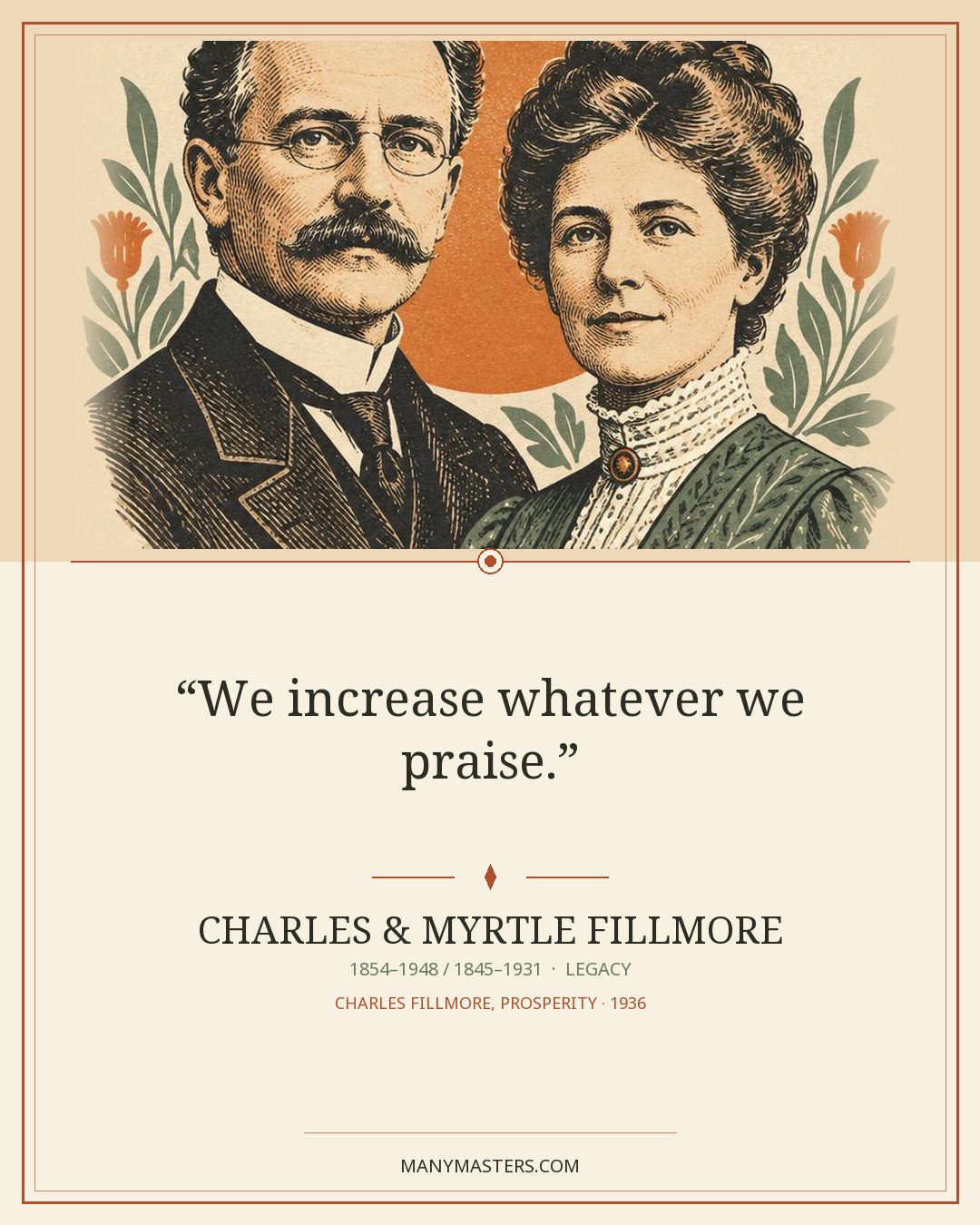
“We increase whatever we praise.”
— Charles & Myrtle Fillmore, Charles Fillmore, Prosperity (1936)
Why this master matters
The Fillmores founded Unity, which grew from a small Kansas City prayer circle into a worldwide movement with a 24-hour prayer ministry and a publishing arm that has printed these ideas continuously for well over a century.
Ideas in practice
Understand the teaching.
01
Affirmation as declaration
Unity's affirmations are statements of what is held to be already true, not wishes — a distinction that changes how they are spoken.
02
Prayer as a shared service
Silent Unity made prayer an always-available service, institutionalising support rather than leaving it to individuals.
03
Supply is a channel, not a store
Fillmore writes about prosperity as flow: what is circulated returns, what is hoarded stalls.
Signature works
Start with the books.
Explore a short reading list, with purchasing links that support ManyMasters.
Start here
Prosperity
Charles Fillmore's most practical book, and the clearest entry point to Unity's approach to supply.
Explore editionsChoosing an edition
These titles are long out of copyright, so editions range from careful annotated reprints to hasty print-on-demand scans. Before buying, check that the listing names a publisher, shows a readable interior sample, and keeps the original chapter structure intact.

Affiliate disclosure: ManyMasters may earn a commission from qualifying purchases, at no additional cost to you.
Choose your path
Read for what you need now.
Historical context
This work belongs to the late-nineteenth and early-twentieth century New Thought movement. Read it as historical writing on belief, attention and character rather than as medical, psychological or financial advice, and treat the biographical stories that grew up around these figures as tradition rather than documented fact.