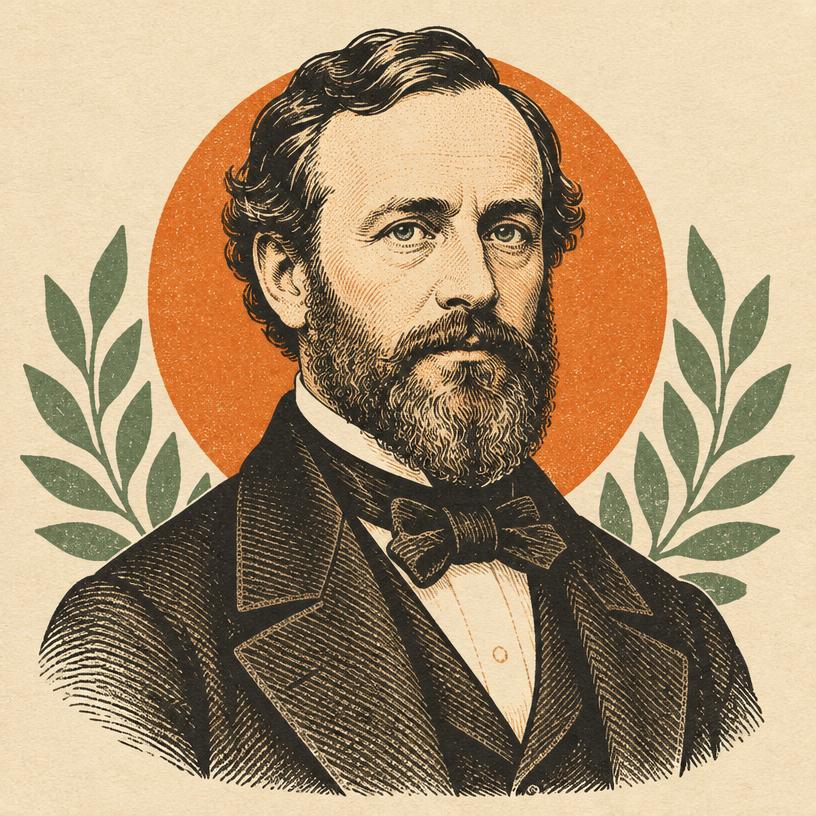
Original editorial artwork; not a historical photograph.
Legacy · 1838–1893
Julius Dresser
A Quimby patient who, with his wife Annetta, brought the healing method into public teaching.
Dresser was treated by Quimby in the 1860s and later settled in Boston, where he and Annetta taught mental healing and pressed the case that Quimby, not Eddy, had originated the ideas.
The resulting public argument shaped how the movement understood its own origins, and the Dressers' classes trained many early practitioners.
1860s
treated by Quimby
Boston
teaching practice
Advocate
for Quimby's authorship
Ideas associated with the work
- Healing through understanding
- Public teaching of private methods
- Fidelity to the original source
- Mind and health as inseparable
Start with the most famous book
The True History of Mental Science
“The truth cures; error causes the disease.”
— Julius Dresser, The True History of Mental Science (1887)
Why this master matters
Julius Dresser, with his wife Annetta, carried Quimby's method forward and publicly insisted on his authorship when others claimed the ideas as their own. Without the Dressers, the founder of the tradition might have vanished from its record.
Ideas in practice
Understand the teaching.
01
Credit the source
His campaign was about intellectual honesty in a movement prone to reinventing its own origins.
02
Understanding heals
Following Quimby, he held that the curative element is correct understanding, not technique.
03
Practice as a family trade
The Dressers taught, treated and wrote together, passing the work to their son Horatio.
Signature works
Start with the books.
Explore a short reading list, with purchasing links that support ManyMasters.
Start here
The True History of Mental Science
His lecture defending Quimby's place in the movement — short, pointed and historically important.
Explore editionsChoosing an edition
These titles are long out of copyright, so editions range from careful annotated reprints to hasty print-on-demand scans. Before buying, check that the listing names a publisher, shows a readable interior sample, and keeps the original chapter structure intact.

Affiliate disclosure: ManyMasters may earn a commission from qualifying purchases, at no additional cost to you.
Choose your path
Read for what you need now.
Historical context
This work belongs to the late-nineteenth and early-twentieth century New Thought movement. Read it as historical writing on belief, attention and character rather than as medical, psychological or financial advice, and treat the biographical stories that grew up around these figures as tradition rather than documented fact.